
Doorman (Uruguayan Independent Artist)

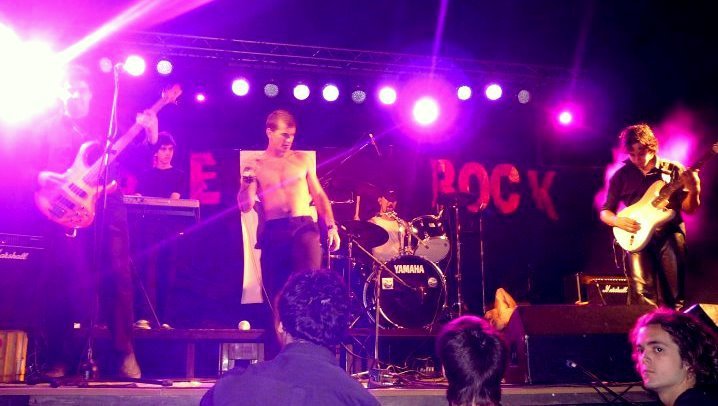
Gustavo "Jack" Doorman Posing With The True Star Of The Band's Debut Album.

Gustavo "Jack" Doorman Posing With The Undisputed Star Of The Band's Debut Album.

F. Scott Fitzgerald once remarked that life is a process of small ruptures that lead to a tremendous final crackdown. Fitzgerald was one of the gigantic voices of reason in the Jazz Age, an era that many scholars simply remember as “the gaudiest spree” in American history. Like it or not, his insight will always stand in that selected place in which truths that are purely forceful in themselves are found.

What I think, however, is that it is conceivable to look at everything from a different angle. What if life were also a process in which one goes through small significant moments that let him finally discover the definitive moment he wants to be in? I am sure it is not far-fetched to think that a person can form his own perception of anything like that.

Personally, I think I can remember the first time a music performance truly moved me. It was the night Glen Hansard and Marketa Irglova won the Academy Award for the song “Falling Slowly”. That was the central piece from “Once”, a musical ingrained in reality that didn’t deny the deep value of dreams for a single minute.

And what struck me really hard was not only the way they played that night, and the radiant chemistry they displayed onstage. It was the words they spoke as they were given their Oscars.

Marketa said “Fair play to those who dream”. Glen simply remarked “Make art… Make art!”.

That night, it dawned on me that if two independent musicians could take on giants like Melissa Etheridge and Disney and walk away victorious, then maybe it would also become possible for Uruguayan musicians to stand up in non-Spanish speaking markets and succeed on their own terms.

Sure, Uruguayan singer/songwriter Jorge Drexler had won an Oscar himself in 2004 for the song “Al Otro Lado Del Río” [Across The River], but it was a bittersweet moment. He was not allowed to take the stage to play the song. Antonio Banderas and Santana played it, with lots of energy but not a lot of precision. When Jorge was awarded the coveted accolade, he sang a portion of “Al Otro Lade Del Río” accapella. I couldn’t help but wonder if that did nothing but highlight how submissive he had had to be to reach that podium that night and walk away with an Oscar. It all felt a little childish, like a girl who kicks a friend in the shin while his parents are holding him, telling him off for something he had done to her.

But that night in 2007, as those two virtually unknown European musicians had left everybody at the Kodak Theater mesmerized with their interpretative skills and integrity I stood as energized as I could be. If there was ever a moment I felt a sense of true possibility materializing, then that was it. I felt (nay, I knew) Uruguayan musicians would one day be able to stand up on their own two feet, and present their art uncompromisingly to the world.

The independent artist I want to cover today has got me thinking about that, along with the best bands currently active in the Uruguayan scene such as The Bear Season and Casablancas. Doorman is an electronic outfit that takes after the name of its frontman, Gustavo “Jack” Doorman. He writes everything and sings the lead, while the remainder of the band comprises Federico Recarey (bass), Ariel Scarpitta (sequencers), Hangel (drums) and Oscar Naya and Lucas Kanopa (guitars).

The band has already issued an album (“Supermal”, produced by Daniel Anselmi) and it stands as an entrancing mixture of buoyant rhythms and lyrics that are mostly hedonistic, although there is also room for contemplation and sheer regret, as in the song “Sad Situations” (one of their most rock-oriented numbers, and a personal favorite of mine). Continue reading

Cínica Releases Its Self-Titled Debut EP

Cínica’s Debut Is A Five-Song EP You Can Download For Free On Their Site

Cínica’s Debut Is A Five-Song EP You Can Download For Free On Their Site

Cínica was the first Uruguayan unsigned artist that I featured on MusicKO, way back in April.

Well, the band has just released its self-titled (and self-funded) debut EP. It has five songs: “Panacea”, “Conciencia” (my personal favorite), “Piso Frío”, “Velo Gris” and an acoustic take on “Panacea” (which closes the disc).

You can get the whole EP for free on their website.

A great way for them to send off the year!

Congratulations!

RostbiF Releases A New EP – Listen To It Online For Free!

RostbiF (Mauricio Rode, Guido Quintela, Lukas Künzler and Pablo Gonzalez) with Andrés Gorlo.

My good friends from RostbiF have just issued a new EP. It is named “La Última Palabra” [The Last Word], and you can listen to its five songs for free here. You can also download the songs to your computer, bring them to any party you go and impress everybody with your knowledge of Uruguayan music. I don’t know if that will make you a big hit with the women at the party (let’s face, it probably won’t), but at least you will be singled out as the one with exotic tastes. That is always a good start…

This is the tracklist:

1- Derrumbe
2- Camino
3- Alice In Cocaineland
4- Paloma
5- Uniformes

This time around I wrote the lyrics to the song “Uniformes” [Uniforms] – I based it on a draft guitarist/vocalist Lukas Kunzer sent me. I have wanted to pen a song with that name ever since I listened to Ken Stringfellow’s song by the same name. And the Birdman has got a (terrific) song that is named like that, too. It is featured on the album “All The Best Cowboys Have Chinese Eyes”. Continue reading

Conkistadores (Uruguayan Unsigned Artist)

Conkistadores Are Gabriel Laborde, Angelo Galeazzi, Darwing Pato Cabana, Jonathan Garcia and Juan Lujambio.

Conkistadores Are Gabriel Laborde, Angelo Galeazzi, Darwing Pato Cabana, Jonathan Garcia and Juan Lujambio.

Hailing from the City of Maldonado, Conkistadores is a recently-formed band whose sound lies somewhere between hard rock and heavy metal. The current lineup comprises singer Gabriel “Rubio” Laborde, guitar player Angelo Galeazzi, drummer Darwing “Pato” Cabana, bassist Jonathan Garcia and keyboard player Juan Lujambio.

They all have played in bands from Maldonado before – Darwing played in “La Mole” and “Gangster”, Gabriel sang with “Minerva”, Angelo was the guitarist for “Cardíacos”… even Juan (the youngest member) is a well-known face in the local scene, having formed his first metal band when he was just 14.

The band has just finished recording its debut EP. It is bound to be released soon, and Conkistadores is playing his first gig in Montevideo on the 13th of November at La Comuna along with the bands Cimarrón and Ginebra (from Salto and Montevideo, respectively).

Musically, Conkistadores references the ‘80s in a dynamic and constant way, with bands like Iron Maiden, Warcry and Yngwie Malmsteen being just some of their clearest standard bearers. But so are Guns ‘n’ Roses, Dream Theater and the Argentinean band Rata Blanca.

You can tell the band members are not new to the game when you listen to them playing. Gabriel’s vocals are sonorous in the best sense of the word. The bass work is decidedly mellifluous, and the guitar is an effective emotional vehicle. More than often, it is hard to believe that the keyboard parts come from someone who is just 15. And Pato is playing the drums with the strength and conviction that only those who have had a close call can muster (he was involved in a near-fatal motorcycle accident not so long ago).

Conkistadores On Stage

Conkistadores On Stage

Out of the six songs that are going to be featured on their debut EP, my personal favorite is “Nadie Escuchó” [Nobody Heard]. It deals with the murder of a 10-year old girl in Maldonado (“Un demente con una estaca de Madera/dejó muda una ciudad entera”) [A madman with a wooden stake/left a whole city speechless] and it is a good example of the band’s ability to touch weighty issues without sounding preachy or overbearing.

The song also has my favorite guitar solo of the whole EP. A true sense of walled desperation is conveyed. Nobody would mistake it for Eric Clapton’s famous weeping guitar, but it is an instrument that is speaking a language capable of moving even those who have not been personally marked and marred by tragedy. Continue reading

Un Accidente Feliz (Lucas Meyer) – Uruguayan Independent Artist

  “Un Accidente Feliz” [A Happy Accident] Was Released By Esquizodelia Records In 2009.

“Un Accidente Feliz” By Lucas Meyer (2009)

It is often said (and accepted either willingly or tacitly, but accepted for good) that these works we love the most are the ones we feel we could have created ourselves. Any work of art strikes a true chord when the story that is narrated is one we feel we could have expressed ourselves, using the very same codes and nuances. It applies to books. It applies to movies. It applies to paintings. And it applies to music, the most direct art of them all. The saddest and the most uplifting conveyances are shaped there.

Still, some say that happiness doesn’t really lead to great works. And there is more than an inkling of truth to that. If anything, it explains the sheer number of albums available where the performer pours his despondency in every word and note. The fact remains that ever since singer-songwriters like Joni Mitchell began articulating personal turmoil in a context that vanished all barriers separating a performer from its public, recording albums that bristled and crackled with disillusionment has become a truly common practice.

More than a few listeners might complain there is a superabundance of such albums. But that is tantamount to saying that there is a set limit of possible answers to the questions posed by sentimental relationships. That is why these albums keep on being produced and released. Some will speak more directly to specific listeners than others. Some answers will hold truer poignancy than others.

And I have just found one that says all I’d have liked to say just a couple of years ago, when I wrote my first book, “Once”. It is by Uruguayan musician Lucas Meyer, and it has been issued by independent label Esquizodelia Records. The name of the album is “Un Accidente Feliz” [A Happy Accident], and like every other record released by the label you can download it for free.

Simply put, it is an album that deals with a romantic rupture. Yet, the corresponding rapture is never far away from the singer’s cinematic focus. It’s as if at the edge of the screen something were happening just outside of the camera’s reach. We never get to see it. But we manage to intuit it, and fill in the major gaps ourselves.

The relationship is revised in retrospect through a voice that is equally capable of expressing “La próxima vez/Voy a involucrarme un poco más/Para tener/Algo para recordar” [Next time/I’ll try to get a little more involved/So that I’ll have/Something to remember] and “Con vos/Va a ser mejor/No hablar/De amor/Va a ser mejor/Demostrártelo” [With you/It’ll be preferable/Not to talk/About love/It’ll be better/Just to show it].

And songs like “Estrella Muerta” [Dead Star] and “Palabras De Desprecio” [Words Of Contempt] deal with the incendiary feelings of dismissal that go with any separation. There’s just no way to “Encontrar La Explicación” [Find The Explanation]. But that’s never a deterrent when the damage has already been done.

On a personal note, I really appreciate the album’s economy. It is obvious that Lucas had enough songs to fill 4 discs if he wanted. He decided to keep everything concise. More than a couple of songs clock at little more than one minute. When reviewing Mateo Moreno’s debut a couple of months ago I found myself remarking that less is often more. “Un Accidente Feliz” is a good example of that. Continue reading

El Cardenal Sebastián (Uruguayan Unsigned Artist)

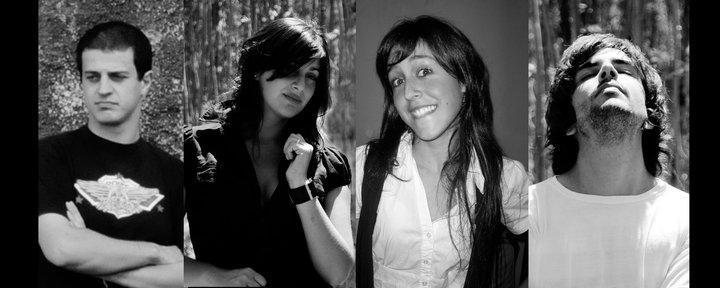
El Cardenal Sebastián Are Carolina Falcon (Vocals) Diego Centurion (Guitar & Backing Vocals), Nadia Costa (Guitar & Backing Vocals) and Juan Pablo Pola (Bass, Keyboards & SFX).

El Cardenal Sebastián Are Carolina Falcon (Vocals) Diego Centurion (Guitar & Backing Vocals), Nadia Costa (Guitar & Backing Vocals) and Juan Pablo Pola (Bass, Keyboards & SFX).

I have in front of me the liner notes that Bill Flanagan penned for Jeff Buckley’s posthumous release, “(Sketches For) My Sweetheart The Drunk”. There, at the end of the first paragraph (the one that invariably holds the deepest poignancy as it has to introduce the subject, and at the same time summarize its blazing successes without overemphasizing the tragedy that truncated his life) I find the one remark that lets me describe this independent Uruguayan band after having lived with its music for the last two weeks.

When explaining Buckley’s reluctance to issue the disc he had recorded with the mythical Tom Verlaine some time before his untimely passing, Flanagan justifies the decision by describing Jeff’s approach to his music (and to his own life) as a process where the actual journey was emphasized over the act of arriving.

That is exactly the impression I have after listening to the music put forth by this band from Canelones. I don’t necessarily think that the songs they have recorded for their first album (named “De La Locura”; it is produced and sold by the band) can be termed a point of arrival in any sense. The music (thankfully) sounds more like a start to me, and that is always commendable when it boils to the first material that any band is releasing. If anything, El Cardenal Sebastián’s music is like a deliberately leveled journey towards an horizon that doesn’t seem that far out of reach. Yet, the horizon that is aimed for is actually an undulating one which makes it hard to discern where it is that the ground ends and the sky commences. The purpose of the actual journey turns into a much trickier one. What lies on one side and what lies on the other? That is the basic question that the band poses. Both the music and the lyrics transmit that sense of a procession towards something which is fated to be in two places at the same time, for the simple reason that, well, such is life. And whatever shortcomings their music might have, you can’t veto it on grounds of failing to express vitality.

In “Detras De Su Piel” [Behind His Skin], singer Carolina Falcón announces “Voy cruzando la ciudad que se enciende” [I go through the city as it lights up], and later in the same song the search for “las semillas de lo incierto” [the seeds of uncertainty] is presented as the one and only valid pursuit. Yet, the song poses the insoluble dilemma of having to root yourself in order to let life germinate and spread from what was once you. That dilemma (the conflict between what one is and one wants to become, that duality again) is precisely what lies at the heart of the song, and of the repertory that the band has unleashed so far.

Another song (De La Locura) includes the lines “Una vez hice el intento de escribirle al sol/quizá bajo los efectos de una pasajera ilusión” [I once tried to write to the sun/maybe under the influence of a fleeting illusion]. And this explicit study of a link between the real world and an illusory state is further developed later on, in the lyrics “Yo viajé por un momento en otra realidad/fue como sentir tus dedos/besando mi tranquilidad” [I traveled for a little while through another reality/it was like feeling your fingers/kissing my tranquility]. Continue reading

Soundays (Uruguayan Independent Artist)

Logo Soundays

Soundays Are Pepelo Curcio (vocals and guitar), Fede Sacarelo (guitar), Juanma Oholeguy (drums) and Diego Placeres (bass).

Soundays Are Pepelo Curcio (vocals and guitar), Fede Sacarelo (guitar), Juanma Oholeguy (drums) and Diego Placeres (bass).

There is a 1975 movie named “Dog Day Afternoon” which tells the story of a pair of bankrobbers who are led by Sonny Wortzik (played by Al Pacino). The movie was directed by Sidney Lumet, and it is still considered a seminal work in the history of anti-establishment films.

I remember that movie every single time I come across any Uruguayan brit pop band. It is the perfect summation of what these bands are attempting to do over here, and I specially think of the scene in which Pacino starts screaming “Attica! Attica!” (an allusion to the Attica Prison riots) in a desperate attempt to make those who have been forced into their company to join them and fight against the system. It just reminds me all too clearly of the fight that such Uruguayan bands aim to put up, and the reactions they cause for all the right and wrong reasons.

I was already disenchanted with the first wave of brit pop bands that emerged in Uruguay (led by Astroboy and Boomerang), if only because those bands always propounded that paying an unveiled homage was synonymous with being creative, and that singing in English challenged the status quo of Uruguayan music. It did not. The ways those bands imitated the music created elsewhere only spoke of a lack of imagination, and it polarized the music scene in a way that meant you couldn’t like La Vela Puerca or No Te Va Gustar if you listened to the Beatles or The Who. I just wonder how many of the musicians involved in Astroboy or Boomerang actually realized that the favorite album of Sebastián Teysera (La Vela Puerca’s singer) was no other than “Tommy” by The Who.

Soundays is a little different from these bands because their influences are certainly wider and that they are very good instrumentalists, but the band is not far removed from other Uruguayan ensembles that sing in English in the sense that you don’t have a thorough understanding of who they are when you listen to their songs. When you listen to their latest EP (“OLHA”; it can be downloaded for free on their site), you just get a mix of styles and influences that don’t add to a cohesive identity. You get to know the bands they appreciate, not the band that they think they are, or the performers that they want to become.

The British influence is all over “Colourful Face” and “Locked Love”, songs that are reminiscent of bands like Blur and Franz Ferdinand – and not necessarily in the best way. For its part, “To Hawaii” adds a West Coast vibe through harmonies that are a bit uneasy, as is the garage rock of “She Feels Like The Weather” (a cut that sounds like The Jam at their most primeval). But it must be said that both “Ghost In My Town” and “Don’t Matter If It Hurts Lights Will Guide Us To The Sun” are distinguished compositions that elicit full-on performances. The latter in particular provides their drummer with a ready chance to take off, and I have to say he is one of the most exciting Uruguayan drummers I have listened to in quite some time. Continue reading

RostbiF (Uruguayan Unsigned Artist) – Part 2: The Music

As I am sure you read in the first part of this article, RostbiF is a hard rock band that hails from Nueva Helvecia (an inland Uruguayan town). The guys cite AC/DC, Deep Purple and ZZ Top as their main references and musical heroes, and their sound is an effective amalgamation of what these bands have played since their inception.

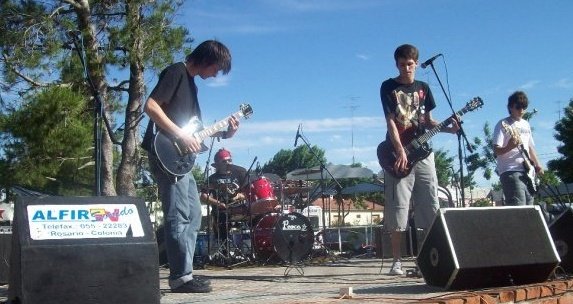
RostbiF Playing Live: Lukas Künzler, Pablo Gonzalez, Mauricio Rode & Guido Quintela

RostbiF Playing Live: Lukas Künzler, Pablo Gonzalez, Mauricio Rode & Guido Quintela

The band comprises Lukas Künzler (lead vocals and rhythm guitar), Pablo Gonzalez (lead guitar), Mauricio Rode (bass) and Guido Quintela (drums).

I am actually acquainted with the guys since Guido e-mailed me about a year ago asking for some lyrics. I did like the fact that they were aiming for compositions that had a certain social content, and I was keen to try something different to the traditional romantic themes I have always used to favor. Thus, “Rebellion Winds” and “These Eyes” were conceived.

One thing that comes across when you listen to their music is how much they are enjoying themselves. They are no virtuosos, they know it, and that is not the point to begin with. They make up for it with a lot of stamina and passion: Guido hits the bass drum as he if were kicking a plancha in the mouth, the bass has true bursts of vigor (specially when it gets some space as on “Rebellion Winds”, their finest composition so far) and the two guitars act as the main offensive line of the band. Granted, nobody would mistake the interplay between Lukas and Pablo as the one that characterized Tom Verlaine and Richard Lloyd, but they are clearly in the same wavelength. Plus, when singing Lukas sounds like a chain smoker who hasn’t had a cigarette in three weeks. Take all that together and the result is the soundtrack for throwing stones and Molotov cocktails at the police during a riot. No wonder I have never attended one of their gigs personally. The last thing I want is someone smashing a bottle willy-nilly in my head. Continue reading

RostbiF (Uruguayan Unsigned Artist) – Part 1: Profile & Interview

It is with great pleasure that I introduce you to the Uruguayan unsigned artist of this week: RostbiF. They are one of the bands I collaborate with, and I can tell you that they are passionate believers in the power of music.

This is their PureVolume profile.

Below you will find the first part of the article, in which they introduce themselves and answer some questions. My own analysis of their music is included here.

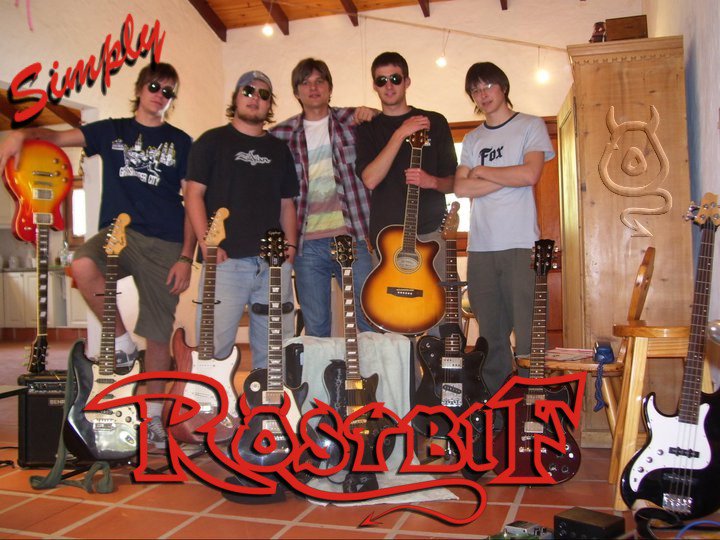
    RostbiF Are Lukas Künzler, Pablo Gonzalez, Mauricio Rode & Guido Quintela

RostbiF Are Lukas Künzler, Pablo Gonzalez, Mauricio Rode & Guido Quintela

Band Information

Name: RostbiF

Genre: Hard rock

Band Members:
Lukas Künzler (Voice and rhythm guitar)
Pablo Gonzalez (guitar)
Mauricio Rode (Bass)
Guido Quintela (Drums)

Been Together Since: Juny 2009

Some Questions

Where does the name of your band come from?

It comes from playing with words and translating them from Spanish into German, but it has no real meaning. The first idea was “rost”, which means “oxid” in German, but we found it to short so we played a little bit with it and the result was RostbiF.

Is it possible to define or categorize your music? If you had to try, how would you do it?

Our music is a kind of mixture from different hard rock styles, it is based on bands like AC/DC, Aerosmith, ZZ Top, Deep Purple, Led Zeppelin… just simple hard rock.

In which ways could your music be deemed as innovative within the Uruguayan scene?  Is that a concern for you?

We think there is no real innovation in our music, we play hard rock the traditional way, that is the music we like to listen to. There is a difference from other Uruguayan bands in the influences, and the type of music we play, but there is nothing new or innovative in it at all.

In which sense being in Uruguay gives you an edge over musicians in other parts of the world? And how does it hinder you? Continue reading

Lucía Ferreira (Uruguayan Unsigned Artist)

Lucia Ferreira

Lucía Ferreira

In one of his most revered poems, Longfellow described the flight of song as something too strong and too constant to be followed by the human eye. If we were to dig deeper into what is implied in that frequently-anthologized lay (what the heck, Gil Grissom actually recites it in one chapter of CSI), we would have to agree that the only point of origin for something which is indeed strong and constant has to be an artist that meets these very two aptitudes. And you can say what you want about Uruguayan artists, but more than a very representative number of performers here certainly shine when it comes to strength, and excel as far as constancy is concerned. The one I would like to tell you a little about now certainly does.

She is named Lucía Ferreira, and during her artistic life she has been part of duets (“No Es Mi Mujer”) [She Is Not My Woman], murgas (“La Japilong”), rock & roll bands (“Vía Libre”) [Free Way]… she is currently playing with Julio Ojeda. Any artist that has treaded so much ground in less than 30 years is not only a well-nurtured one. To all intents and purposes, such an artist is the one who is nurturing to others.

The songs she is currently working on often touch on issues such as self search and the validation of one’s place in the world (that is the thematic denominator of both “Diván” [Couch] and “Me Quiero Quedar” [I Want To Stay]), and the role that art has a mediator between the world that there is and the world that there should be is incarnated in songs like “Vieja Viola” [Old Six-string]. In the song (a tango written by luminary Humberto Correa), an old performer can but look into his former source of pride (his guitar) from a yearning stance that paints a savage contrast with the humdrum of the domesticity he has sunk into. The corollary is that an artist is always a seeker of something else in life, even if that implies that to let others find that something he will have to renounce to his ability to hold onto these things that he has found along the way. Lucía does the song very well, as she has all the necessary vocal chops to convey the world-weariness of the lyrics, if only because a voice that has been tempered by so many styles becomes malleable in itself. Continue reading