Laberinto (La Trampa) – Uruguayan Music

"Laberinto" Was La Trampa's Fifth Album. It Was Issued In 2005 To Good Sales And Mostly Positive Reviews.

"Laberinto" Was La Trampa's Fifth Studio Album. It Was Issued In 2005 To Good Sales And (Mostly) Positive Reviews.

“Laberinto” [Labyrinth] constitutes the fifth album of original material released by Uruguayan rockers La Trampa. Alongside La Vela Puerca, No Te Va Gustar and Buitres the band possesses immense popularity in the country; and like the aforementioned bands, it has been making inroads in the Argentinean market.

This time around there is a strong presence of both Uruguayan and Argentinean folk music in the compositions (all penned by guitarist Garo Arakelian), which coupled with the traditional approach of the band results in a captivating listening experience. The entrance to this particular labyrinth is not that unusual, though: “Puente De Estrellas” [Bridge Of Stars], “Las Décimas” [The Ten-line Stanzas] and “El Poeta Dice La Verdad” [The Poet Tells The Truth] are classic La Trampa, competing with the best moments of preceding albums such as “Caída Libre” [Free Fall] (2002).

However, come the fourth selection, a “zamba” (an Argentinean rhythm, not to be confused with the Brazilian “samba”) titled “Ronda De Lenguas” [Round Of Tongues] and the thread abruptly disappears, leaving the listener wondering how to proceed. The bands playfully leads him through a maze of gentle songs interspersed with harder-sounding offerings, until “Vagos Recuerdos” [Vague Memories] signalizes the way out. Along the way he is bound to find “Canciones Al Viento” [Songs To The Wind], which combines a measured introduction with an energetic conclusion, emphasizing the will to transcend of the lyrics (“Quiero una canción que vuele cuando ya no vuele yo/Que se haga viento en el aire cuando no respire yo/Quiero un viento que te cante cuando ya no cante yo”) [I want a song that flies when I no longer fly/That becomes wind in the air when I no longer breathe/I want a wind that sings for you when I no longer sing] and the salient “Pensares” [Thoughts], bearing the most realized chorus of the whole album, alongside a pensive guitar solo that complements the lyrics perfectly. Continue reading

Cinco Estrellas (Astroboy) – Uruguayan Music

"Cinco Estrellas" Was Astroboy's Debut EP

"Cinco Estrellas" Was Astroboy's Debut EP

The emergence of a band like Astroboy in the Uruguayan market was understandable. Uruguay’s endemic genres like Tango, Murga, and Candombe have always held little sway over the tastes of youth, whereas popular bands like La Vela Puerca or No Te Va Gustar still fail to strike a chord with listeners weaned on British and American music. Astroboy attempted to bridge that gap with the release of their debut album, a seven-song EP entitled “Cinco Estrellas” [Five Stars]. The EP was issued in 2003.

Verily, they sing in English, and their approach differs from traditional Uruguayan Rock, but problems abound. First of all, they may sing in English, but they do not compose songs in English. It is palpable that the words are devised in Spanish and then translated into English, with little regard for the nuances of each language. This is denoted by the rhymes they resort to (when they do rhyme), and by the rhyme schemes in use – these never move beyond the basic ABCB. And when they do try (as in “Did I Tell You?”), they wind up coupling words like “drowning” with “laughing”. And the lyrics themselves are a drawback, as they are plagued by grammar and syntax problems (I check my meanings/And all my kinds are ways/ That I don’t mind/Yeah!).

Moreover, a tendency to take the easy way out is already pronounced here; some compositions are made up of just one verse and one chorus reiterated throughout the whole song, as in “Fácil” [Easy] and the closing “Time Has Passed” (a bonus track, and the weakest song on offer). Some (minor) confusions between British and American English are also in evidence. But the most egregious aspect is the music itself, wholly derivative of Britpop bands (most notably Oasis). There is a difference between being inspired by something and imitating something; it is a thin line, but Astroboy crosses it gratuitously. From Oasis they also take the attitude and general outlook (especially singer Martín Rivero, who hero-worships Liam Gallagher). Continue reading

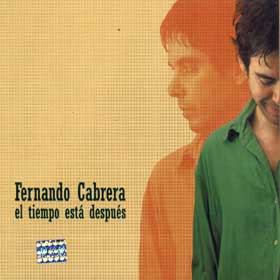
El Tiempo Está Después (Fernando Cabrera) – Uruguayan Music

"El Tiempo Está Después" Was Issued In 2004. It Covers Fernando Cabrera's Very First Years As A Solo Artist.

"El Tiempo Está Después" Was Issued In 2004. It Covers Fernando Cabrera's Very First Years As A Solo Artist.

The first Uruguayan album I purchased was this compilation by Fernando Cabrera, and it only makes sense he is the one artist I have chosen to inaugurate this section of MusicKO with.

Born in 1956 in Montevideo, he is one of the most respected composers in the whole country. He performs what we call “Música popular”, a category that is comparable with folk music in English-speaking countries to a considerable extent. His primary instrument is the guitar, and his MO on the whole is not that removed from artists I adore like Elvis Costello, XTC and Richard Thompson in the sense that he is a very distinguished lyricist whose vocal delivery is anything but mainstream, and while that costs him some wider appeal it gives him a certain exclusiveness that make him all the more beloved by his followers.

This compilation was first issued in the year 2004, and it gathers together the best cuts from his first three solo recordings (he had been part of the groups “MonTRESvideo” and “Baldío” during the late 70s and early 80s). These albums are “Autoblues” (1985), “Buzos Azules” (1986) and “El Tiempo Está Después” (1989).

Fourteen tracks are featured. Some are very short, like the opening “Iluminada” [Illuminated] and the set closer “No Te Olvidés” [Don’t You Forget], some rock quite energetically like “Tangente” [Tangent] and “Agua” [Water], and some have a lovely River Plate sensibility such as “La Garra Del Corazón” [The Drive Of The Heart] and “Los Viajantes” [The Travelers], with “La Garra Del Corazón” being actually a tango. But every single composition could be described as (to quote Bobby Darin) true poetry in motion. That is particularly true when it comes to the track that lends its title to the album, which in English is rendered as “Time Comes Afterwards” and the phenomenal “Imposibles” [Impossible Things] and “Pandemonios” [Pandemoniums]. Continue reading

Uruguayan Music – General Introduction

A Great Still Of One Of Our Main Squares, "Plaza Independecia"

A Great Still Of One Of Our Main Squares, "Plaza Independecia"

Despite being Uruguayan and having lived my whole life in the capital of the country (Montevideo), I do not have that much of a thorough understanding of local bands. That is probably because I was always more interested in English music. That is, I was keener on anything that was English-related when I was younger: books, music, TV shows… Now I have broadened the specter considerably.

In a certain sense, I think that most people go through something similar when they are young: they sort of reject the music from the place they live in, however good it is. I am sure that young people in Rome dislike the local scene, I am sure that youngsters in Berlin look askance at their own local bands, I know that there are young people in Buenos Aires that look elsewhere for their musical kicks. It is completely natural. When we are a certain age, we are bored with the world that surrounds us. A foreign sound is always more motivating. It speaks of another way of living and a different sense of freedom. That is invaluable when we are young and we feel that the world constricts us. Continue reading

Fabian Severo’s Speech – Launch Event For The Book “Once”

(Hagan click aquí para leer este artículo en español)

I would like to share with you the speech that Fabián Severo gave at the launch event for my book, “Once”. Fabián is a literature teacher and a writer. He has recently been involved in the launch of a book written with secondary school children named “Fruto Del Desierto” [The Fruit Of The Desert], and a second volume named “Huellas de viento en la arena” [Traces Of The Wind In The Sand] has just been completed.

I thank him warmly for being there that day, and for the speech he gave.

His blog is found here:

http://yiribibe.blogspot.com

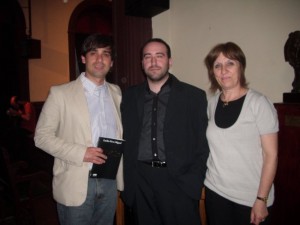
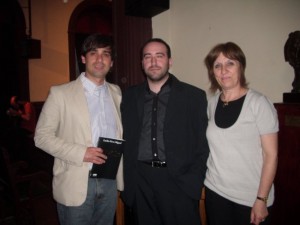
With Fabián Severo (Left) And Publisher Carmen Galusso (Right).

With Fabián Severo (Left) And Publisher Carmen Galusso (Right).

“It is a great joy to take part of the launch of a book of poems because I feel that poetry is the one literary genre that gives readers the biggest interpretative freedom. It brings us the maximum of feelings, emotions and ideas in a minimum of words.

Those who teach at institutes of education have always tried to make us believe language is noting but an instrument, and they taught us its functions. Ivonne Bordelois once wrote “we are forgetting that a language is above all a pleasure – a sacred pleasure – and probably the highest form of love and knowledge”. Language itself is free, democratic, sympathetic and revolutionary. Free and democratic because it reaches everybody at no cost. Sympathetic because it us a meeting point – a whole community shares it. And revolutionary because through it norms are trespassed and innovations arise. “And it is poets – along with children –the ones who notice the ample and secret possibilities that a language brings, and they either toy with it or become its toys.”

Emilio Pérez Miguel defines in a beautiful line one of the roles a poet plays out: “dar vos a lo que otro siente” [voice what other feels]. When one reads “Once”, in some of his poems, verses and quotes one is bound to find a feeling, a reflection or an idea that belongs to him.

Emilio Pérez has managed to surprise with this book. He has managed to trespass some frontiers. He has modified the conventional structure of books – there is no foreword, there is no index, after the introduction we go straight into the second chapter and we stay there, strolling through poems that change from one day to the other, that combine two titles, that pose questions that are answers. We read definitions, concepts, footnotes. Continue reading

Disertación de Fabián Severo – Presentación Del Libro “Once”

(Click here for the English version of this post)

Quisera compartir con ustedes la disertación brindada por Fabián Severo en la presentación de mi libro, “Once”. Fabián es profesor de literatura y escritor. Recientemente ha publicado un libro escrito por sus alumnos titulado “Fruto del desierto”, y un segundo volumen llamado “Huellas de viento en la arena” ha sido completado en estos días.

Le agradezco de corazón que me acompañara en ese día tan importante, y por las palabras que nos brindó a todos.

Este es su blog:

http://yiribibe.blogspot.com

Con Fabián (A La Izquierda) Y La Editora Carmen Galusso En La Presentación Del Libro.

Con Fabián (A La Izquierda) Y La Editora Carmen Galusso En La Presentación Del Libro.

“Es una dicha participar en una presentación de un libro de poemas porque considero que la poesía es, dentro de los géneros literarios, el que más libertad de interpretación brinda al lector. Máximo de emociones, máximo de sentimientos, máximo de ideas, en un mínimo de palabras.

En las instituciones educativas intentaron hacernos creer que el Lenguaje era un instrumento, y nos enseñaron sus funciones. Dice Ivonne Bordelois: “Nos olvidamos de que el lenguaje es ante todo un placer, un placer sagrado; una forma, acaso la más elevada, de amor y de conocimiento”. El lenguaje es un bien gratuito, democrático, solidario y revolucionario. Democrático y gratuito, porque llega a todos de forma gratuita, solidario porque es un lugar de encuentro, lo comparte toda una comunidad y revolucionario porque a través de él, se transgrede la norma y se realizan innovaciones.  “Y son los poetas -junto con los niños- los que primero advierten las posibilidades más amplias y secretas del lenguaje y juegan o se dejan jugar con ellas.”

Emilio Pérez Miguel define en un hermoso verso una de las funciones del poeta cuando dice: “…dar vos a lo que otro siente.” Cuando uno lee “Once”, en alguno de sus poemas, de sus versos, de sus citas, encontrará algún sentimiento, alguna reflexión, alguna idea que le pertenece.

Emilio Pérez ha logrado sorprender con este libro, ha logrado transgredir algunas fronteras. Ha modificado la estructura, no hay prólogo, no hay índice, de la introducción pasamos al segundo capítulo y en él nos quedamos, paseando por poemas que cambian de días, que combinan dos títulos, que plantean preguntas que son repuestas, leemos definiciones, conceptos, notas al dorso. Continue reading