
Free Music For Download From Uruguayan Label Esquizodelia Records

Esquizodelia Records logo

Uruguayan label Esquizodelia Records has just released two cool compilation albums. These feature one song apiece from each artist on the label. You can get them on Esquizodelia Records’ website, absolutely for free.

A lot of genres are covered, and you are bound to find something interesting there for sure. And once you do, you can listen to even more music from these artists – the full albums can also be downloaded for free.

What do you think about these artists? Which one seems more promising to you? Leave a comment below and let everybody know!
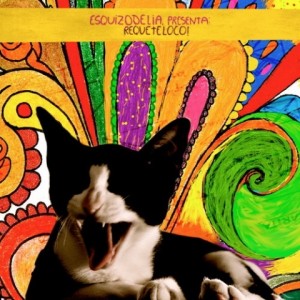
Requeteloco

RequeteLOCO:

1. DDD3 – Gaby Cows
2. Uoh! – ( L )
3. Siameses R.I.P – On the cremation of Chogyam Thungpa Vidyadhara
4. Relacionessexuales – Whiskeria
5. Fiesta Animal – Trafico de niños
6. 8 – Deep Flamba
7. Psiconautas – On my own
8. La Mugre Roja – Rock n Roll pt.II

Requetefantastico

RequeteFANTASTICO:

1. 3Pecados – Sin titulo 3
2. Solar – Uno menos
3. Genuflexos – Dance
4. Disaster – Leave my head
5. Lucas Meyer – Encontrar la explicación
6. Millonesdecasasconfantasmas – Hoy
7. El boulevard de lulu – Y de a poco
8. Roly Chamber – Cars


Soundays (Uruguayan Independent Artist)

Logo Soundays

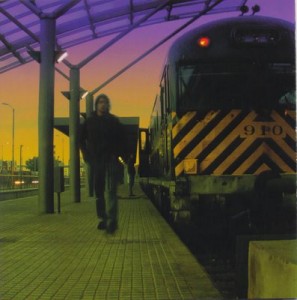
Soundays Are Pepelo Curcio (vocals and guitar), Fede Sacarelo (guitar), Juanma Oholeguy (drums) and Diego Placeres (bass).

Soundays Are Pepelo Curcio (vocals and guitar), Fede Sacarelo (guitar), Juanma Oholeguy (drums) and Diego Placeres (bass).

There is a 1975 movie named “Dog Day Afternoon” which tells the story of a pair of bankrobbers who are led by Sonny Wortzik (played by Al Pacino). The movie was directed by Sidney Lumet, and it is still considered a seminal work in the history of anti-establishment films.

I remember that movie every single time I come across any Uruguayan brit pop band. It is the perfect summation of what these bands are attempting to do over here, and I specially think of the scene in which Pacino starts screaming “Attica! Attica!” (an allusion to the Attica Prison riots) in a desperate attempt to make those who have been forced into their company to join them and fight against the system. It just reminds me all too clearly of the fight that such Uruguayan bands aim to put up, and the reactions they cause for all the right and wrong reasons.

I was already disenchanted with the first wave of brit pop bands that emerged in Uruguay (led by Astroboy and Boomerang), if only because those bands always propounded that paying an unveiled homage was synonymous with being creative, and that singing in English challenged the status quo of Uruguayan music. It did not. The ways those bands imitated the music created elsewhere only spoke of a lack of imagination, and it polarized the music scene in a way that meant you couldn’t like La Vela Puerca or No Te Va Gustar if you listened to the Beatles or The Who. I just wonder how many of the musicians involved in Astroboy or Boomerang actually realized that the favorite album of Sebastián Teysera (La Vela Puerca’s singer) was no other than “Tommy” by The Who.

Soundays is a little different from these bands because their influences are certainly wider and that they are very good instrumentalists, but the band is not far removed from other Uruguayan ensembles that sing in English in the sense that you don’t have a thorough understanding of who they are when you listen to their songs. When you listen to their latest EP (“OLHA”; it can be downloaded for free on their site), you just get a mix of styles and influences that don’t add to a cohesive identity. You get to know the bands they appreciate, not the band that they think they are, or the performers that they want to become.

The British influence is all over “Colourful Face” and “Locked Love”, songs that are reminiscent of bands like Blur and Franz Ferdinand – and not necessarily in the best way. For its part, “To Hawaii” adds a West Coast vibe through harmonies that are a bit uneasy, as is the garage rock of “She Feels Like The Weather” (a cut that sounds like The Jam at their most primeval). But it must be said that both “Ghost In My Town” and “Don’t Matter If It Hurts Lights Will Guide Us To The Sun” are distinguished compositions that elicit full-on performances. The latter in particular provides their drummer with a ready chance to take off, and I have to say he is one of the most exciting Uruguayan drummers I have listened to in quite some time. Continue reading

RostbiF (Uruguayan Unsigned Artist) – Part 2: The Music

As I am sure you read in the first part of this article, RostbiF is a hard rock band that hails from Nueva Helvecia (an inland Uruguayan town). The guys cite AC/DC, Deep Purple and ZZ Top as their main references and musical heroes, and their sound is an effective amalgamation of what these bands have played since their inception.

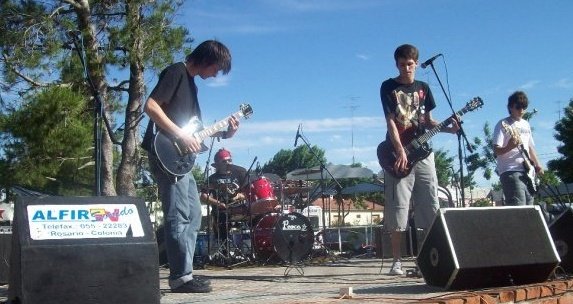
RostbiF Playing Live: Lukas Künzler, Pablo Gonzalez, Mauricio Rode & Guido Quintela

RostbiF Playing Live: Lukas Künzler, Pablo Gonzalez, Mauricio Rode & Guido Quintela

The band comprises Lukas Künzler (lead vocals and rhythm guitar), Pablo Gonzalez (lead guitar), Mauricio Rode (bass) and Guido Quintela (drums).

I am actually acquainted with the guys since Guido e-mailed me about a year ago asking for some lyrics. I did like the fact that they were aiming for compositions that had a certain social content, and I was keen to try something different to the traditional romantic themes I have always used to favor. Thus, “Rebellion Winds” and “These Eyes” were conceived.

One thing that comes across when you listen to their music is how much they are enjoying themselves. They are no virtuosos, they know it, and that is not the point to begin with. They make up for it with a lot of stamina and passion: Guido hits the bass drum as he if were kicking a plancha in the mouth, the bass has true bursts of vigor (specially when it gets some space as on “Rebellion Winds”, their finest composition so far) and the two guitars act as the main offensive line of the band. Granted, nobody would mistake the interplay between Lukas and Pablo as the one that characterized Tom Verlaine and Richard Lloyd, but they are clearly in the same wavelength. Plus, when singing Lukas sounds like a chain smoker who hasn’t had a cigarette in three weeks. Take all that together and the result is the soundtrack for throwing stones and Molotov cocktails at the police during a riot. No wonder I have never attended one of their gigs personally. The last thing I want is someone smashing a bottle willy-nilly in my head. Continue reading

RostbiF (Uruguayan Unsigned Artist) – Part 1: Profile & Interview

It is with great pleasure that I introduce you to the Uruguayan unsigned artist of this week: RostbiF. They are one of the bands I collaborate with, and I can tell you that they are passionate believers in the power of music.

This is their PureVolume profile.

Below you will find the first part of the article, in which they introduce themselves and answer some questions. My own analysis of their music is included here.

    RostbiF Are Lukas Künzler, Pablo Gonzalez, Mauricio Rode & Guido Quintela

RostbiF Are Lukas Künzler, Pablo Gonzalez, Mauricio Rode & Guido Quintela

Band Information

Name: RostbiF

Genre: Hard rock

Band Members:
Lukas Künzler (Voice and rhythm guitar)
Pablo Gonzalez (guitar)
Mauricio Rode (Bass)
Guido Quintela (Drums)

Been Together Since: Juny 2009

Some Questions

Where does the name of your band come from?

It comes from playing with words and translating them from Spanish into German, but it has no real meaning. The first idea was “rost”, which means “oxid” in German, but we found it to short so we played a little bit with it and the result was RostbiF.

Is it possible to define or categorize your music? If you had to try, how would you do it?

Our music is a kind of mixture from different hard rock styles, it is based on bands like AC/DC, Aerosmith, ZZ Top, Deep Purple, Led Zeppelin… just simple hard rock.

In which ways could your music be deemed as innovative within the Uruguayan scene?  Is that a concern for you?

We think there is no real innovation in our music, we play hard rock the traditional way, that is the music we like to listen to. There is a difference from other Uruguayan bands in the influences, and the type of music we play, but there is nothing new or innovative in it at all.

In which sense being in Uruguay gives you an edge over musicians in other parts of the world? And how does it hinder you? Continue reading

Lucía Ferreira (Uruguayan Unsigned Artist)

Lucia Ferreira

Lucía Ferreira

In one of his most revered poems, Longfellow described the flight of song as something too strong and too constant to be followed by the human eye. If we were to dig deeper into what is implied in that frequently-anthologized lay (what the heck, Gil Grissom actually recites it in one chapter of CSI), we would have to agree that the only point of origin for something which is indeed strong and constant has to be an artist that meets these very two aptitudes. And you can say what you want about Uruguayan artists, but more than a very representative number of performers here certainly shine when it comes to strength, and excel as far as constancy is concerned. The one I would like to tell you a little about now certainly does.

She is named Lucía Ferreira, and during her artistic life she has been part of duets (“No Es Mi Mujer”) [She Is Not My Woman], murgas (“La Japilong”), rock & roll bands (“Vía Libre”) [Free Way]… she is currently playing with Julio Ojeda. Any artist that has treaded so much ground in less than 30 years is not only a well-nurtured one. To all intents and purposes, such an artist is the one who is nurturing to others.

The songs she is currently working on often touch on issues such as self search and the validation of one’s place in the world (that is the thematic denominator of both “Diván” [Couch] and “Me Quiero Quedar” [I Want To Stay]), and the role that art has a mediator between the world that there is and the world that there should be is incarnated in songs like “Vieja Viola” [Old Six-string]. In the song (a tango written by luminary Humberto Correa), an old performer can but look into his former source of pride (his guitar) from a yearning stance that paints a savage contrast with the humdrum of the domesticity he has sunk into. The corollary is that an artist is always a seeker of something else in life, even if that implies that to let others find that something he will have to renounce to his ability to hold onto these things that he has found along the way. Lucía does the song very well, as she has all the necessary vocal chops to convey the world-weariness of the lyrics, if only because a voice that has been tempered by so many styles becomes malleable in itself. Continue reading

Los Amigos Invisibles (Sordromo) – Uruguayan Music

“Los Amigos Invisibles” was Sordromo’s Final Album. It Came Out In 2004. Julio Berta Had Been Replaced By Martín Craciun, But Otherwise It Was The Same Lineup.

Sordromo’s fourth (and valedictory) album, “Los Amigos Invisibles” [“The Invisible Friends”] contains some of their best music together, but also a number of compositions that sound like nothing but rehashes of songs they had previously offered up. These compositions do not dominate the album in any sense, but they speak of a strained creative process, and upon listening to the album today it becomes evident why Rodrigo Gómez left the band shortly after the album had been issued.

To shunt the negative songs out of the way once and for all: “Lejos De Casa” [Far Away From Home] derives its melody and tonal structure from the song “Desnorteados” from the previous album, only that this time it lacks all punch. “Tanto Control” [So Much Control] and “Llamame” [Call Me] are clear examples of volume that tries to convey sentiment and that only ends up conveying patchiness.  “Nota Para Un Viaje” [Note For A Travel] is no much better, but it is placed right before the first truly good composition of the album (the title track), and there is a thematic bond at play that makes it more palatable.

But the one song that can’t be stomached no matter how much you try is “Un Secreto” [A Secret], where Sordromo apes the brit sound of bands like Astroboy. This song alone tarnishes the first side of the album irrevocably – and most of the compositions I criticized above were already segregated there to begin with.

Still, it is on the first side of “Los Amigos Invisibles” where we find one of Sordromo’s most memorable hits, “Lucerito” (a tale of broken farewells and reconstituted memories). The song has really exciting dynamics, and the breaks are as good as the ones found on “2 + 2= 3”, where the drums virtually jump from the speakers and run over you.  And the first side also hosts the angsty “El Filo Del Tiempo” [The Edge Of Time], a song that anticipates the hat trick that will close the album. “La Calma Y La Tormenta” [The Calm And The Storm], “A Punto De Equivocarme” [Just About To Make A Mistake] and “Inevitablemente” [Inevitably].

The three songs are linked by the despondency of the lyrics, and in “A Punto De Equivocarme” [Just About To Make A Mistake] Rodrigo’s voice sounds as if he were about to break down at any moment. It is a song in which emotions strafe the listener, and not a single bullet misses the target.

It works perfectly as the prelude to “Inevitablemente” [Inevitably], of course. The song is rendered solely by Rodrigo (he sings and plays the acoustic guitar), and his voice sounds bitten, as if after the previous caterwaul of emotions he has finally wiped the tears away, but tearing a bit of skin in the process. The song makes me think a lot of The Smiths’ final song, “I Won’t Share You”. Similar circumstances (creative differences), same message (it was good until it lasted, but that was it). Continue reading

Mal Yo (Uruguayan Unsigned Artist)

Mal Yo

“Mal Yo” [My Fault] is a Uruguayan trio that plays good ol’ rock & roll. It comprises guitarist/lead singer Diego Da Silva, bassist Martín Bernasconi and drummer Sergio Alastra. Sergio is actually slightly older than the rest, and (to my ear) he is the standout musician in the band. Yes, I have some catching up with the doctor to do.

Seriously, now, he provides the most memorable passages in their songs – look at the way in which he sustains the tension during the choruses to “La 22”, or the killer triplet that he uses to wrap up “A Tiempo” after having shifted beats all through the song. Besides, any person who has had the nerve to play in a band named “El Tatú Lunar” [The Lunar Tattoo] and then in another that was named “Monos Con Navajas” [Monkeys With Blades] has earned my absolute admiration. He must get invited to fewer parties than me.

The band is currently recording its debut album, and a couple of their songs can be downloaded for free on their website. (They can also be streamed on their MySpace page). These are “A Tiempo” [In Time], “Tu Lugar” [Your Place] and “La 22” [Table Number 22]. I have to admit that I am not really bowled over by their music on the whole, but one of these three songs has got me interested like little else. I must have listened to the song “A Tiempo” more than the three guys combined with all of their families and friends. Cubed. I honestly don’t recall having done something like that before, and that was the reason I decided to write about them. Because I don’t really like the other two songs they have, as I find the main riffs just a tad too generic – the main riff in “La 22”, for example, reminds me too much of songs like “Tu Dei” by Dsus4 (another Uruguayan band, and one that is sadly playing the great gig in the sky after having released a reasonably good debut album in 2006 entitled “Nada Permanece Quieto” [Nothing Remains Still]).

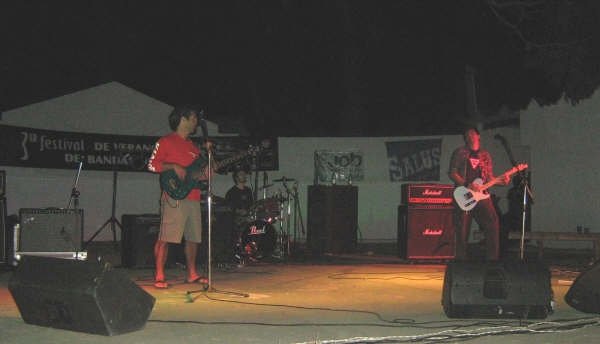
Mal You Playing Live: Martín Bernasconi, Sergio Alastra & Diego Da Silva

Mal Yo Playing Live: Martín Bernasconi, Sergio Alastra & Diego Da Silva

“A Tiempo” is the one song of theirs that sounds fresh and invigorating, and the lyrics display a very realized use of alliterative figures. Each verse is topped and tailed with the expressions “A veces” [Sometimes] and “A tiempo” [In Time], and the chorus is quite impacting, especially the second time around. The song also has a distinctive structure, as it comprises only two verses and a chorus that is played once and then repeated after the solo before the song concludes. That shifts the thematic emphasis of the lyrics, which being topped and tailed as described above would be imbued with a sort of conciliatory (or at least conclusive) air. This turns the song into something that ends up expressing losses that one would have thought were to be averted: “Y nosotros dos añoramos/nuestra vida perfecta” [And the two of us long for/our perfect life]. Continue reading

Laiojan Sebastian (Uruguayan Independent Artist)

Laiojan Sebastian Were Andrés Pardo Di Nardo, Alejandro Reyes, Andrés Puppo & Ismael Pardo Di Nardo

Laiojan Sebastian Were Andrés Pardo Di Nardo, Alejandro Reyes, Andrés Puppo & Ismael Pardo Di Nardo

Laiojan Sebastian was the band that made me decide to cover Uruguayan unsigned artists on MusicKO. I learned of their existence in late 2009. I had recently became acquainted with Ismael Pardo Di Nardo, the drummer and percussionist of the band. His older brother Andrés was the lead singer and sole composer of the songs the band (a very representative exponent of River Plate rock) was to record for a self-titled debut that was sadly never to be released. I recall the impression that the CD caused on me when Ismael played the first song (“Despierta”) [Wake Up] over his speakers – it was a truly alive piece of music. It felt as if the message of the lyrics had been deprived of its mobility by the indifference that befell the whole album, but its ability to move others remained unscathed. I wouldn’t say that I become an awakened one that day. But I felt less dormant for certain.

Of course, that the disc hit me so hard when I first listened to it was no coincidence – not when I learned that the bass player and the lead guitarist were Andrés Puppo and Alejandro Reyes, two professional musicians that had been part of the local scene for some time now.

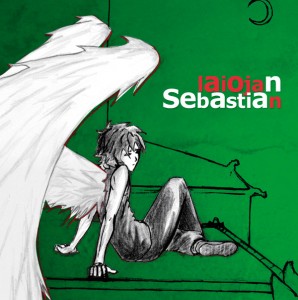
Another thing that caught my immediate fancy was the cover art. Andrés had designed it, and a well-known Argentinean comic artist put his thumb into motion to bring the nominal character to life. The manga influence was palpable by a mile, and the Iojan Sebastian that we can see pictured there seemed the closest to a living paradox to me, with a mien that expressed as many emotions as the ones it counter-expressed. I could imagine him saying “It is all in vain. Nothing means anything except everything. And you can get everything in life except nothing. But” – he would continue with a grin – “there is always a way to get anything.”

And if “Despierta” was a song that told of latent possibilities, the remaining songs were to deal with their realization. One of the clearest examples was to be “Jhonny Balón”, a fairy story about a child soccer prodigy that dies during a match only to resurrect and score at the last minute as his team reaches the final many years later. The song offers up a raving mixture of funky passages  with murga drumming (conveying the tragedy of the protagonist’s death) and in the last section (the match) Andrés emulates a commentator over real ambience noise. Continue reading

Retrocedonia (Uruguayan Unsigned Artist)

Retrocedonia Are Pablo Sassi, Sergio Astengo, Ana Garland & Alejandro Tuala

Retrocedonia Are Pablo Sassi, Sergio Astengo, Ana Garland & Alejandro Tuala

A band that got me quite intrigued, Retrocedonia is more pop than rock, but it can rock far more than your conventional poppy outfit. More than anything, it is a band whose sound melds old and new Uruguayan traditions in a very idiosyncratic way – they clearly know what has come and gone before and they make sure indicators are dropped all over the place, but not in a way that would devaluate what they are actually doing.

That is something tricky to pull off – to many younger listeners, the musical history of the country is often anything but cool or hip. They won’t necessarily listen to someone who plays an accordion and sings about the Mama Vieja (one of the most representative protagonists of Uruguayan Candombe) as this band does. Continue reading

Superpunk! – Jorge Nasser Vs. Jorge Bonomi & Fernán Cisnero (Tiempos Salvajes)

This is a classic of Uruguayan radio. The incident took place one Saturday in March, 1993. Jorge Bonomi & Fernán Cisnero hosted a radio show named “Tiempos Salvajes” [Wild Times] in which they routinely abused one of the most popular rock bands of the day, Niquel. The band was fronted by Jorge Nasser and Pablo Faragó, and the hosts of the show looked askance at them because they regarded themselves as tough rock & rollers. They deemed Niquel’s approach as something sissy. They were making fun of the band live on air, and taking special umbrage at their recently-released symphonic album. Jorge Nasser (the singer and leader of the band) had enough. He headed straight to the studio, and by a bizarre twist of fate he got in without anybody noticing. He stood at the other side of the booth’s door, listening to the final segment of the show.

When the two hosts began picking on Niquel again, he exploded. Nasser stormed into the studio and gave the two radio hosts a beating to write home about. And it was all broadcast because the operator (fearing for her safety) ran away so quickly that she forgot to turn the mikes off.

“Stop it, man, stop it! Let’s talk it over!”. That was the only thing the radio hosts could repeat during the beating. When the first bout was over and Nasser stood towering over both of them, one of the hosts (completely scared out of his brains) squelched “Call the cops!”. Nasser’s retort has gone down in the history of Uruguayan radio.

“¡Ja! ¿Pero no sos el superpunk? ¿No sos el súperagresivo? ¿No es que te gusta la música con personalidad? Bueno, poné personalidad, jugate por lo que decís”.

[“¡Ha! Ain’t you a superpunk? Ain’t you a super-aggressive one? Don’t you always say you like music with personality? Come on, put a little personality to use, walk it the way you talk it”.]

Below you can download the audio in its entirety – you can listen to the first part of the show, the beating and then the mention the two hosts made to the incident the following Saturday.

People being people, I know you will want to listen to the beating first. Jump to 02:58. The “superpunk” bit comes at 04:24.

Superpunk – Jorge Nasser Vs. Jorge Bonomi & Fernán Cisnero (Tiempos Salvajes)