It happens to all of us, no matter how musically proficient we are – when we listen to a song we complain about the voice coming in too low, the guitar coming in too soft, the drums sounding like tin biscuits… It is basic nature, in the same way we claim that we could give the current coach of this or the other team a good run for his money, or that we could be in charge of any given company and do more good than the actual person who stands as its chairman.
But can we? As far as music is concerned, now it looks like we can indeed. GoMix is a brand new site that will let you take songs and remix them yourself, without the need to download anything in order to get going. A browser-based editor is used, and you can cut and paste everything and then start readjusting it. Continue reading →
"Closer" Compiles Together Sarah Mc Lachlan's Greatest Hits Up To The Year 2008
This one took a little to sink in, and it didn’t sink in completely. But the bits that managed to do it are ones I now treasure indeed. Sarah Mclachlan is a Canadian artist that began her career in 1988 with the album “Touch”, in which her trademark mixture of folk and pop was already fully manifested. That record included the hit single “Vox”, and that is the one song which starts this 16-track compilation which was first issued in 2008.
I think I don’t have to tell you it is one of the tracks that I truly treasure from it. The other two that I deem as exemplary songs are “Possession” and “Building A Mystery”. Both were quite successful in terms of chart performance – “Building A Mystery” topped the Canadian charts and almost hit the top 10 in the US. For its part, “Possession” garnered a lot of publicity since it dealt with a famous stalker that even filed a lawsuit against McLachlan – he was to eventually commit suicide before the trial started.
Some might find it startling that songs dealing with such negative realities turn out to be such compelling listens – just look at Elvis Costello’s “High Fidelity” or The Police’s “Every Breath You Take”. But when songs like that are successful, I don’t think that means people are “evil”– quite the opposite. It just showcases that “normal” people are naturally attracted to what happens on the other side. The more people who are keen on songs like these, then, the more representative sample we have of people’s saneness. Continue reading →
Traditionally, if your favorite band was playing and you couldn’t get there for a reason or the other there was little you could do but sit in your room and sulk all night. Alternatively, you could take the Keith Moon approach and trash the room beyond recognition. Neither option was really healthy, so I am not surprised a system like Awdio was (finally) devised.
Basically, this French startup will let you listen to the sound of clubs and venues on your desktop. So far, something like 150 venues are supported and the list is growing fast. 150 clubs mean that through the site you will have access to roughly 5,000 events per month. Now the question will not be what to listen to but rather what to skip in order to keep up with your social life. Continue reading →
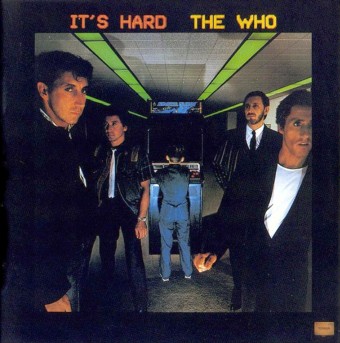
The songs on The Who’s final record with Kenny Jones have a distinctive characteristic: many were written “to order” by Pete. That is, Roger and John requested that certain issues were touched upon and that is why we have a song about the health system (“Cook’s County”) and one about war (“I’ve Known No War”). These work in tandem with John’s “Dangerous”, about urban violence and security.
“Cook’s County” has the sad merit of being hailed by fans as one of the worst songs ever recorded by the band. The other is “Armenia, City In The Sky”, though to be fair that one was penned by Pete’s chauffeur at the time, Speedy Keene. ”I’ve Known No War” is better as it has a longer running time in which motifs are established and both the instruments and the vocals peak, culminating in an orchestrated fade.
The title track was actually reworked from an opera of Pete about each person being a soul under siege, and it has some mixed wordplay. But it is mostly compelling when taken as a whole. Continue reading →
Three years after Keith Moon had passed away, Pete must have been regretting they ever carried on. His attitude had changed for sure, as he began pumping out solo releases which in hindsight were to be the place to turn to if you were looking for The Who’s zest. Because The “New” Who on record and The “New” Who on stage were completely different entities.
Live, Kenny had to replicate Keith’s arrangements, and he was quite capable of doing that (they never, ever did “Happy Jack” with Kenny, though). As a studio drummer, it was a different story. He could drum excitingly enough for any band (“You Better You Bet” and “Daily Records” are clear examples), but nobody could ever hold a torch to Keith’s inventive performances in the studio. That wasn’t Kenny’s fault, certainly. And to be fair, Keith could never have played military drums like the former Small Faces drummer did on “Cry If You Want”. But he was under so much pressure and attention that it must have been unbearable. And Roger was hostile to him from day one. Continue reading →
The MidemNet Lab Is Taking Place At The MIDEM Music Conference In Cannes, France
The inaugural MidemNet Lab will take place at the MIDEM music conference in Cannes, France (23rd – 27th January 2010).
It will be the spot where the 15 best startups that bring digital innovation into the world of music will be highlighted. These have been voted by some of the key players in the industry – leaders of sites such as MySpace, Spotify and Seesmic opined on which startups should be featured. Continue reading →
"Laberinto" Was La Trampa's Fifth Studio Album. It Was Issued In 2005 To Good Sales And (Mostly) Positive Reviews.
“Laberinto” [Labyrinth] constitutes the fifth album of original material released by Uruguayan rockers La Trampa. Alongside La Vela Puerca, No Te Va Gustar and Buitres the band possesses immense popularity in the country; and like the aforementioned bands, it has been making inroads in the Argentinean market.
This time around there is a strong presence of both Uruguayan and Argentinean folk music in the compositions (all penned by guitarist Garo Arakelian), which coupled with the traditional approach of the band results in a captivating listening experience. The entrance to this particular labyrinth is not that unusual, though: “Puente De Estrellas” [Bridge Of Stars], “Las Décimas” [The Ten-line Stanzas] and “El Poeta Dice La Verdad” [The Poet Tells The Truth] are classic La Trampa, competing with the best moments of preceding albums such as “Caída Libre” [Free Fall] (2002).
However, come the fourth selection, a “zamba” (an Argentinean rhythm, not to be confused with the Brazilian “samba”) titled “Ronda De Lenguas” [Round Of Tongues] and the thread abruptly disappears, leaving the listener wondering how to proceed. The bands playfully leads him through a maze of gentle songs interspersed with harder-sounding offerings, until “Vagos Recuerdos” [Vague Memories] signalizes the way out. Along the way he is bound to find “Canciones Al Viento” [Songs To The Wind], which combines a measured introduction with an energetic conclusion, emphasizing the will to transcend of the lyrics (“Quiero una canción que vuele cuando ya no vuele yo/Que se haga viento en el aire cuando no respire yo/Quiero un viento que te cante cuando ya no cante yo”) [I want a song that flies when I no longer fly/That becomes wind in the air when I no longer breathe/I want a wind that sings for you when I no longer sing] and the salient “Pensares” [Thoughts], bearing the most realized chorus of the whole album, alongside a pensive guitar solo that complements the lyrics perfectly. Continue reading →
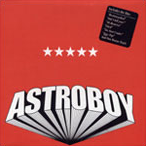
The emergence of a band like Astroboy in the Uruguayan market was understandable. Uruguay’s endemic genres like Tango, Murga, and Candombe have always held little sway over the tastes of youth, whereas popular bands like La Vela Puerca or No Te Va Gustar still fail to strike a chord with listeners weaned on British and American music. Astroboy attempted to bridge that gap with the release of their debut album, a seven-song EP entitled “Cinco Estrellas” [Five Stars]. The EP was issued in 2003.
Verily, they sing in English, and their approach differs from traditional Uruguayan Rock, but problems abound. First of all, they may sing in English, but they do not compose songs in English. It is palpable that the words are devised in Spanish and then translated into English, with little regard for the nuances of each language. This is denoted by the rhymes they resort to (when they do rhyme), and by the rhyme schemes in use – these never move beyond the basic ABCB. And when they do try (as in “Did I Tell You?”), they wind up coupling words like “drowning” with “laughing”. And the lyrics themselves are a drawback, as they are plagued by grammar and syntax problems (I check my meanings/And all my kinds are ways/ That I don’t mind/Yeah!).
Moreover, a tendency to take the easy way out is already pronounced here; some compositions are made up of just one verse and one chorus reiterated throughout the whole song, as in “Fácil” [Easy] and the closing “Time Has Passed” (a bonus track, and the weakest song on offer). Some (minor) confusions between British and American English are also in evidence. But the most egregious aspect is the music itself, wholly derivative of Britpop bands (most notably Oasis). There is a difference between being inspired by something and imitating something; it is a thin line, but Astroboy crosses it gratuitously. From Oasis they also take the attitude and general outlook (especially singer Martín Rivero, who hero-worships Liam Gallagher). Continue reading →
The technology we have available today might not have been put to the best use when it came to engaging users. That is the lasting impression I was left with after browsing through this site. The company (a transatlantic one) builds iPhone apps that take the music created by electronic artists, and then it lets you come up with tunes of your own by using the accelerometer from the iPhone along with the sounds that surround you. This is what the company calls “reactive music”. That is, music marked by activeness on the user instead of the passiveness of sitting while a song is playing, merely tapping your fingers away and so on. Continue reading →
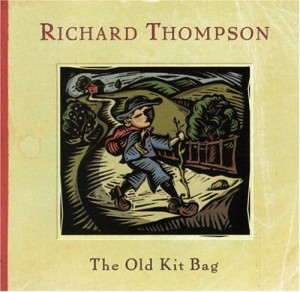
Richard’s first album of the century found him in a small label for the first time in more than two decades, and the record itself was to have a streamlined approach, with few musicians and a sound that was far removed from the layered approach that had marked/marred his 90s output. Perversely enough, the new formula worked quite magically – the record hit the Billboard Top 200, and the top 5 of the Indie charts. The truth is producer John Chelew came closer to capturing Richards’ rotund live sound than virtually anybody else – for sure much closer than Mitchell Froom.
The title of the album references a World War I song, as it is only fit since the record has a conceptual tinge of boys that grow to become soldiers only to be hit by the intricacies of destiny and the egotism and apathy of the adult world – “the fire in your eyes/how could they know”, Richard sings on the set opener, the fiercely beautiful “Gethsemane”. The first side of the record also has the Celtic-styled “One Door Opens”, probably one of the album highlights with vocalist Judith Owen (a recent associate that joins long-time bassist Danny Thompson and drummer Michael Jerome) providing a rich backdrop, something she does not only on that tune but on more than half the tracks.
This backing becomes even more noticeable in one of the closing numbers, the tension-riddled “Word Unspoken, Sight Unseen”. Richard mutes the guitar, and he lets it ring only when the intensity is such that the lyrical flow demands a sturdier backbone so that the song won’t collapse.
“Word Unspoken, Sight Unseen” is placed next to the Eastern-derived “Outside Of The Inside”, which is (appropriately enough) a song about Muslim faith and the way a radical sees Western culture. Continue reading →