The Stanford Mobile Phone Orchestra

How does technology and traditionalism have been getting on lately? Leaving aside Robert Murdoch’s ongoing battle with search engines so that print media will retain its inherent force and exclusivity, I think that the year was a good one in terms of bringing together ends that might always have been deemed as too opposite. Of course, it was the year of social media (“unfriend” was voted the word of the year by the Oxford University Press), and it was a year in which we saw Twitter crowned as the supplest way to spread news – the plane landing in the River Hudson, the elections in Iran…

And where does music stand in all this? Obviously, social media has modified the way people promote and market music. I just don’t think that CDs and physical music would become a thing of the past anytime soon (look here), but there is a clearly new portion of music consumers that grows exponentially, and that is already colossal (IE, young people taken as a whole). And now, a new development has taken place when it comes to the actual performing of music. Continue reading

El Tiempo Está Después (Fernando Cabrera) – Uruguayan Music

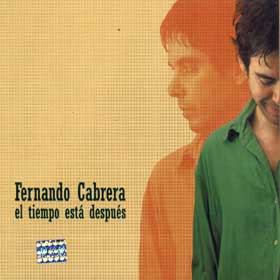
"El Tiempo Está Después" Was Issued In 2004. It Covers Fernando Cabrera's Very First Years As A Solo Artist.

"El Tiempo Está Después" Was Issued In 2004. It Covers Fernando Cabrera's Very First Years As A Solo Artist.

The first Uruguayan album I purchased was this compilation by Fernando Cabrera, and it only makes sense he is the one artist I have chosen to inaugurate this section of MusicKO with.

Born in 1956 in Montevideo, he is one of the most respected composers in the whole country. He performs what we call “Música popular”, a category that is comparable with folk music in English-speaking countries to a considerable extent. His primary instrument is the guitar, and his MO on the whole is not that removed from artists I adore like Elvis Costello, XTC and Richard Thompson in the sense that he is a very distinguished lyricist whose vocal delivery is anything but mainstream, and while that costs him some wider appeal it gives him a certain exclusiveness that make him all the more beloved by his followers.

This compilation was first issued in the year 2004, and it gathers together the best cuts from his first three solo recordings (he had been part of the groups “MonTRESvideo” and “Baldío” during the late 70s and early 80s). These albums are “Autoblues” (1985), “Buzos Azules” (1986) and “El Tiempo Está Después” (1989).

Fourteen tracks are featured. Some are very short, like the opening “Iluminada” [Illuminated] and the set closer “No Te Olvidés” [Don’t You Forget], some rock quite energetically like “Tangente” [Tangent] and “Agua” [Water], and some have a lovely River Plate sensibility such as “La Garra Del Corazón” [The Drive Of The Heart] and “Los Viajantes” [The Travelers], with “La Garra Del Corazón” being actually a tango. But every single composition could be described as (to quote Bobby Darin) true poetry in motion. That is particularly true when it comes to the track that lends its title to the album, which in English is rendered as “Time Comes Afterwards” and the phenomenal “Imposibles” [Impossible Things] and “Pandemonios” [Pandemoniums]. Continue reading

Uruguayan Music – General Introduction

A Great Still Of One Of Our Main Squares, "Plaza Independecia"

A Great Still Of One Of Our Main Squares, "Plaza Independecia"

Despite being Uruguayan and having lived my whole life in the capital of the country (Montevideo), I do not have that much of a thorough understanding of local bands. That is probably because I was always more interested in English music. That is, I was keener on anything that was English-related when I was younger: books, music, TV shows… Now I have broadened the specter considerably.

In a certain sense, I think that most people go through something similar when they are young: they sort of reject the music from the place they live in, however good it is. I am sure that young people in Rome dislike the local scene, I am sure that youngsters in Berlin look askance at their own local bands, I know that there are young people in Buenos Aires that look elsewhere for their musical kicks. It is completely natural. When we are a certain age, we are bored with the world that surrounds us. A foreign sound is always more motivating. It speaks of another way of living and a different sense of freedom. That is invaluable when we are young and we feel that the world constricts us. Continue reading

Ooizit – A Social Networking Site For Musicians In The United Kingdom

Ooizit

Name: Ooizit
URL: http://www.ooizit.com

You might wonder why are new social networks for musicians still being released when we have resources like MySpace available, and you have a point. But you must understand that to people located in specific parts of the world, the idea of networking locally is attractive by definition. That is, if they know the ones who are found within a given network share at least a certain geographical proximity, it is all the more enticing. The WWW has brought a whole elasticity when it comes to collaborating with others, yet if we were given the choice of collaborating over the Internet and doing it face to face then we all know which way we’d go. Continue reading

Mock Tudor (Richard Thompson) – Album Review (Part 2)

(The first part of this review can be read here)

The second section of the album (“Heroes in the Suburbs”) is the one that includes “Crawl Back (Under My Stone)”, “Uninhabited Man”, and “Walking The Long Miles Home”. These are an idiosyncratic reagge-ish number, a celtic-flavored composition and a song which is “a little bit country” respectively. I especially like “Crawl Back (Under My Stone)”, a number in which the character conveys as much self-esteem as it is necessary for him to achieve his aim – don’t be fooled, he is not as  innocuous as he might seem. And “Walking The Long Miles Home” has catchy choruses on the strength of the rhyme scheme that is employed. The lyric is funny, too.

This part of the album also has “Dry My Tears And Move On”, a song not dissimilar to a soul ballad that might as well have the best middle eight of the whole record. Continue reading

Mock Tudor (Richard Thompson) – Album Review (Part 1)

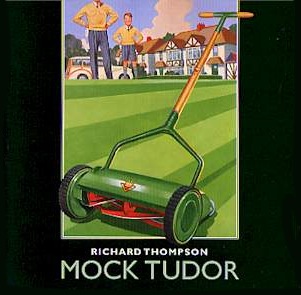
Richard Thompson's "Mock Tudor" Was First Issued In 1999. It is Spli In Three Parts That Chronicle Life In The Suburbs During The 20th Century.

Richard Thompson's "Mock Tudor" Was First Issued In 1999. It is Split In Three Parts That Chronicle Life In The Suburbs All Through The 20th Century.

Mock Tudor was Richard Thompson’s final album under his Capitol Records’ contract. It was released in 1999, and it was the one album of the decade not produced by Mitchell Froom, the man who is known for his glossy approach to record-making. That is always a recurrent point when the album is discussed. The fact remains that Thompson is a gritty performer, and a rawer approach for capturing him in action always works best.

That is exemplified by the first three tracks, two of which were issued as singles (the polka “Cooksferry Queen” and “Bathsheba Smiles”), and that stand as very fine vignettes about outlaws and people who walk the line. “Cooksferry Queen” paints the picture of an outright ruffian that is transfixed by love, putting himself at the mercy of the other – as Yasu, the leader of the band Black Stones (or “Blast”) from the anime “Nana” used to say, those who once laughed at love will cry because of it in the end.

And “Batsheba Smiles” is a very pointed portrait of a woman akin to Coleridge’s Christabel, IE the kind of woman that is always there for everybody but never there for any person in particular. The chorus of the song is specially powerful, with the “Do you close your eyes to see miracles/Do you raise your face to kiss angels/Do you float on air to hear oracles” section showcasing the effects such a person has on others, and how initial admiration turns into bitterness very quickly indeed. Continue reading

Dan Dabner (Songstall) – Interview (Part 2)

This is the second (and final) part of the interview with Dan Dabner from Songstall. If you haven’t done so already, you can check out part 1 here.

PART II

MUSIC & YOU

When did you become interested in music? What was the first album or single you ever purchased?

When I was younger my mum listened to the singles chart on the radio every Sunday, so I had a feel for some pop music, but my brother introduced me to heavy metal when I was about eight or nine and I think I bought a tape of Metallica’s Black Album so I’d have my own copy.

Are you in a band yourself, or have you been in a band in the past? Is there a file on YouTube or elsewhere we could watch?

I used to play the keys in the lonelyband a few years ago but sadly the band split in 2006.  I’m not aware of any videos on YouTube but naturally our music was the first available on Songstall!  http://www.songstall.com/thelonelyband Continue reading

Dan Dabner (Songstall) – Interview (Part 1)

Dan Dabner from Songstall (the startup I introduced you to last week) was kind enough to be interviewed on MusicKO. This is the first part of the interview I conducted with him– proceed here for part 2.

Songstall

Full Name: Dan Dabner
Age: 24
Startup: Songstall
Position: Director

PART I

THE STARTUP

Tell us a little about your startup. How was it conceived? What are the features that (in your opinion) give it an edge over the competition?

The idea for Songstall came from a discussion between my brother and me while we were jamming one evening.  As musicians ourselves we know what it’s like to be an unsigned artist and all the options out there are based around the ideal of getting signed by a big record label.  All the services that offer to help in that long-term goal (promotion, recording, etc) always seem to charge high up-front fees that we know most artists simply can’t afford and prices them out of the market.  That’s where Songstall comes in – you don’t need a record label to sell your music online, and we don’t charge anything to sign up.  We just take a cut on any sale artists make to cover costs so we only make money if they do, which means our interests are aligned with theirs.  In addition, artists get their own customizable shop page so they can set their own prices, choose their own colours and get their own URL they can promote at their gigs.  We’ve not seen another service that offers all of this.

What was the original launch date?

We launched the website on Halloween 2009.  How rock ‘n’ roll is that?

What has been the response so far? In which countries has it been more successful?

We’ve had some very positive feedback about the website and the sign-ups are really picking up.  We’ve been most popular in the UK, USA and Canada, though we do offer our service world-wide. Continue reading

The Gift (The Jam) – Album Review

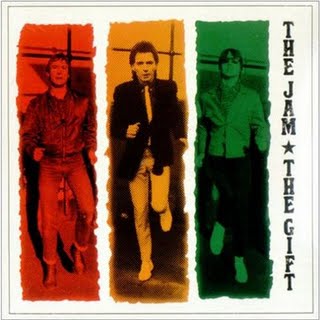
The Jam's Final Studio Album Was Issued In 1982. It Was Named "The Gift".

The Jam's Final Studio Album Was Issued In 1982. It Was Named "The Gift".

The Gift was to be the final Studio album cut by The Jam, and it simply showcases how Weller ambitions had massively outgrown the band. In places it sounds like a Style Council record that has Foxton and Buckler looking over their shoulders and glancing at the spots their musical ideas where when they began. Because they had little to contribute by this point. It is not necessarily their fault – Weller has come up with some textures and grooves that are totally un-Jam like, in the same way that Pete Townshend brought along influences for the recording of The Who’s “Who Are You” that left many band members (especially  Keith Moon) stranded. When that happens, a band takes its last bows and walks offstage.

These style excursions that do not work include “The Planner’s Dreams Go Wrong” and “Circus”, while “Running On The Spot” has potential that is never realized. Still, some compositions do work out to a lesser or bigger extent – “Precious” is quite effective, and the monster hit “Town Called Malice” gave everybody high hopes for the album (it was released some time ahead of the record, coupled with “Precious”). For its part, the soulful title track falls somewhere in the middle. Continue reading

Songstall – An Online Marketplace For Unsigned Musicians

Songstall

Name: Songstall
URL:  http://www.songstall.com

Every musician knows that the Internet is akin to a freeway of opportunities when it comes to promoting his art and getting through to others. But it is a freeway that has some hazards along the way. While it is true that it is a superb platform for self-promotion and selling your music, it is also true that many sites that act as online marketplaces have a series of inherent limitations that make the experience a somehow diluted one. For starters, many of these sites do charge fees that end up making the actual transaction negligible. And a vast majority of sites letting artists put up their music for sale make the artist undergo a lengthy approval process for his tunes to be listed.

If you are looking for a way of getting around these shortcomings, then I think a site like this one could be worth a gander. Named Songstall (and recently launched, by the way), it will let any unsigned artist sell his compositions without having to pay any over-the-top fee, nor having to sit through a lengthy process in order to have his music listed online. Artists will be charged only when a sale is made. Continue reading